
Your Child Doesn’t Have Two Problems. They Have One.
If your child struggled with speech and is now struggling to read, this is not a coincidence.
Picture this: your child comes home from second grade with a reading log that’s barely touched. They avoid books. They cry during homework. They can sound out three-letter words, but the moment a word gets longer, it falls apart. Their teacher suggests a reading evaluation. You think back to the speech therapy your child had in preschool, the sounds they couldn’t say, the years of weekly sessions, the discharge report that said they were “within functional limits,” and you wonder if any of it is connected.
It is. Almost certainly.
And here’s what nobody told you at that discharge meeting: speech and reading are two different expressions of the same underlying system.
It All Starts With Sound
Long before your child ever sees a letter, their brain is doing something remarkable: sorting the sounds of their language into categories. Is this a short, stopped sound like /b/, the kind that cuts off the moment it starts? Or a long, continuous sound like /m/ that you can stretch and hold? Does it come from the front of the mouth or the back?
Think of it like a filing system. Every sound in English gets its own folder in the brain, its own clear, distinct slot. When that filing system works well, everything built on top of it works too. When the folders are disorganized, mislabeled, or hard to tell apart, the problems that follow are predictable.
In the early years, those filing problems show up in speech. A child whose sound system is disorganized struggles to produce sounds correctly. The mouth is usually capable. The brain’s plan for the sound is fuzzy. That is what a Speech Sound Disorder looks like underneath the surface.
But here’s the part that changes everything: those same folders are exactly what reading depends on.
When the Filing System Meets the Page
When your child learns to read, their brain doesn’t start over. It takes the same sound filing system and connects each folder to a written symbol. The sound /b/, the first sound in “bat,” becomes the letter b. The short vowel in “cat” becomes the letter a. Those are the straightforward ones.
But English is complicated. The long a sound is spelled differently in “cake,” “rain,” “play,” “they,” and “great.” The same letters make different sounds in different words. For a child whose sound folders were never cleanly organized to begin with, that complexity makes the whole system feel like chaos.
And the filing problems that were audible in their speech, the substitutions, the inconsistencies, the sounds that came and went, are now visible on the page. The problem didn’t change. The way we see it did. This is the moment speech becomes print, and that is not a metaphor. Reading and writing are speech-to-print tasks at their core. Every word on a page is a spoken word in a visual disguise.
Which means that for a child with this history, struggling to read is not a vision problem or an attention problem. It is the same speech problem, showing up in print, and it calls for a speech-to-print intervention.
What the Research Shows
This connection is well documented. The numbers are striking:
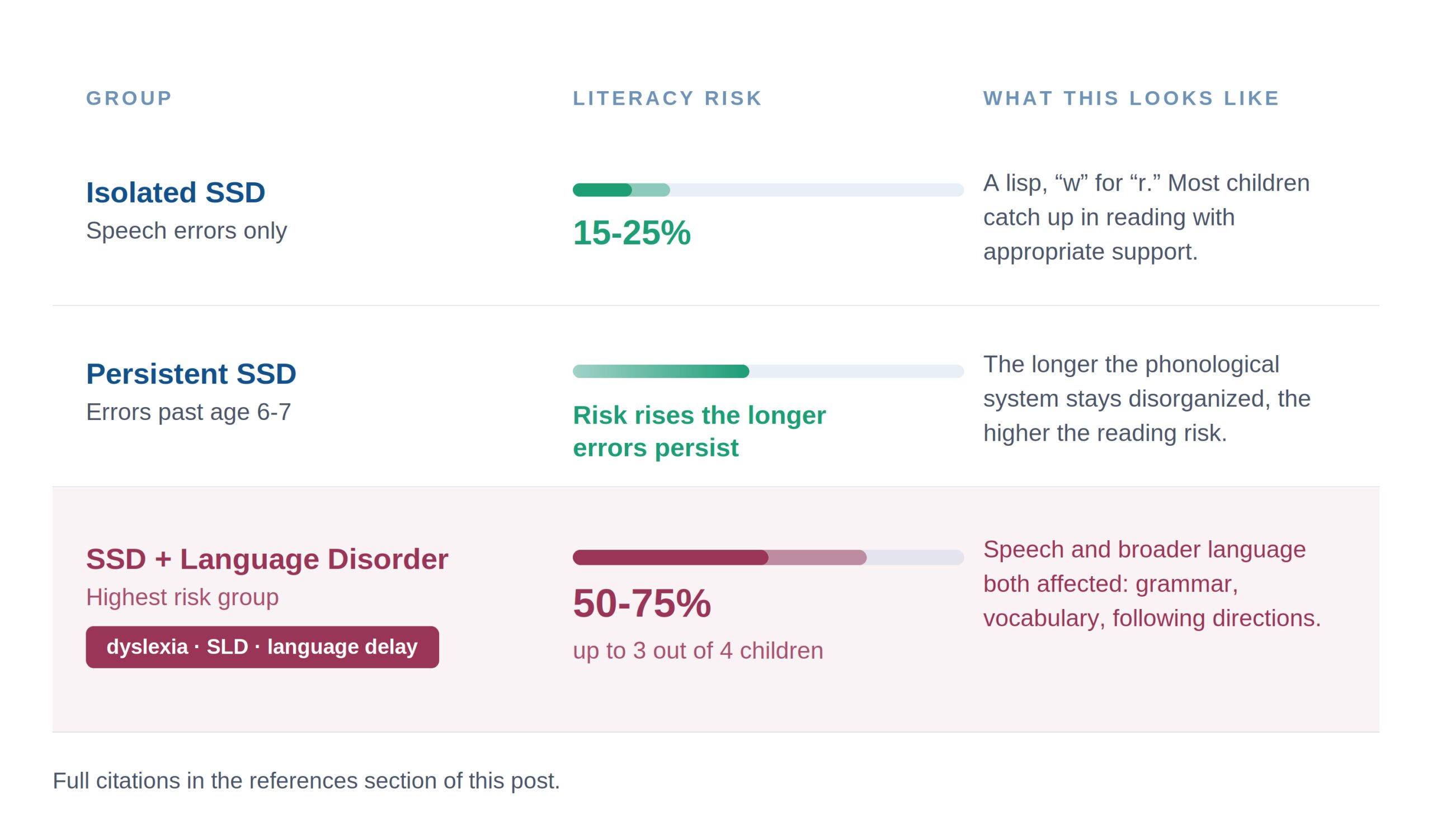
The highest-risk group, children with both a Speech Sound Disorder and a language disorder, faces a 50 to 75% rate of literacy difficulty. Up to three out of four children. And they are routinely sent to separate specialists as if the connection doesn’t exist.
One more detail that matters: children whose speech errors were unusual or atypical, the kind that go beyond a typical “wabbit” for “rabbit,” carry a higher risk than children who were simply a little delayed. If that sounds like your child, it’s worth paying attention to.
A recent meta-analysis confirmed the pattern across decades of studies. What predicted reading outcomes was not how severe a child’s speech errors sounded. It was how disorganized the underlying sound system was.
Why Two Specialists May Not Be the Answer
The typical path looks like this: speech therapy in preschool, discharge at kindergarten entry, reading concerns flagged in first or second grade. A reading specialist steps in with no knowledge of your child’s speech profile and no framework for connecting the two.
Nobody is doing anything wrong. But nobody is seeing the whole picture either.
When one clinician understands both sides, the speech history, the phonological foundation, and the literacy demands, the intervention changes. The sound work and the reading work reinforce each other in the same session, building the same underlying system from two directions at once.
That is what integrated intervention looks like. For children with this profile, it is the difference between treating the symptom and treating the cause.
Does This Sound Like Your Child?
- Speech sound errors that persisted past age five, especially unusual substitutions
- Difficulty rhyming or identifying the first sound in a word
- A parent or sibling with dyslexia or reading difficulties
- Strong verbal skills that don’t match their reading and spelling
- Multisyllabic words that consistently fall apart
- Slow, effortful reading despite adequate instruction and effort
If several of these are true, your child doesn’t need two separate evaluations from two separate specialists. They need one clinician who understands how these pieces fit together. Because they do. They always did.
References
- Walquist-Sørli, L., Caglar-Ryeng, Ø., Furnes, B., Nergård-Nilssen, T., Donolato, E., & Melby-Lervåg, M. (2025). Are speech sound difficulties risk factors for difficulties in language and reading skills? A systematic review and meta-analysis. Journal of Speech, Language, and Hearing Research, 68(1), 164-177. https://doi.org/10.1044/2024_JSLHR-24-00170
- Tambyraja, S. R., Farquharson, K., & Justice, L. (2020). Reading risk in children with speech sound disorder: Prevalence, persistence, and predictors. Journal of Speech, Language, and Hearing Research, 63(11), 3714-3726.
- Hayiou-Thomas, M. E., Carroll, J. M., Leavett, R., Hulme, C., & Snowling, M. J. (2017). When does speech sound disorder matter for literacy? The role of disordered speech errors, co-occurring language impairment and family risk of dyslexia. Journal of Child Psychology and Psychiatry, 58(2), 197-205.
- Lewis, B. A., Avrich, A. A., Freebairn, L. A., Hansen, A. J., Sucheston, L. E., Kuo, I., Taylor, H. G., Iyengar, S. K., & Stein, C. M. (2011). Literacy outcomes of children with early childhood speech sound disorders: Impact of endophenotypes. Journal of Speech, Language, and Hearing Research, 54(6), 1628-1643.
- Catts, H. W., Fey, M. E., Tomblin, J. B., & Zhang, X. (2002). A longitudinal investigation of reading outcomes in children with language impairments. Journal of Speech, Language, and Hearing Research, 45(6), 1142-1157.
Rebecca Pearson, M.S., CCC-SLP/L is a licensed speech-language pathologist specializing in dyslexia, structured literacy, phonological processing, and motor speech disorders. She is Orton-Gillingham certified through IMSE, PROMPT Level 1 trained, and currently completing certification as a Structured Literacy Dyslexia Interventionist. The Literacy Loop serves children and families in the western suburbs of Chicago.
By Rebecca Pearson, M.S., CCC-SLP/L
